
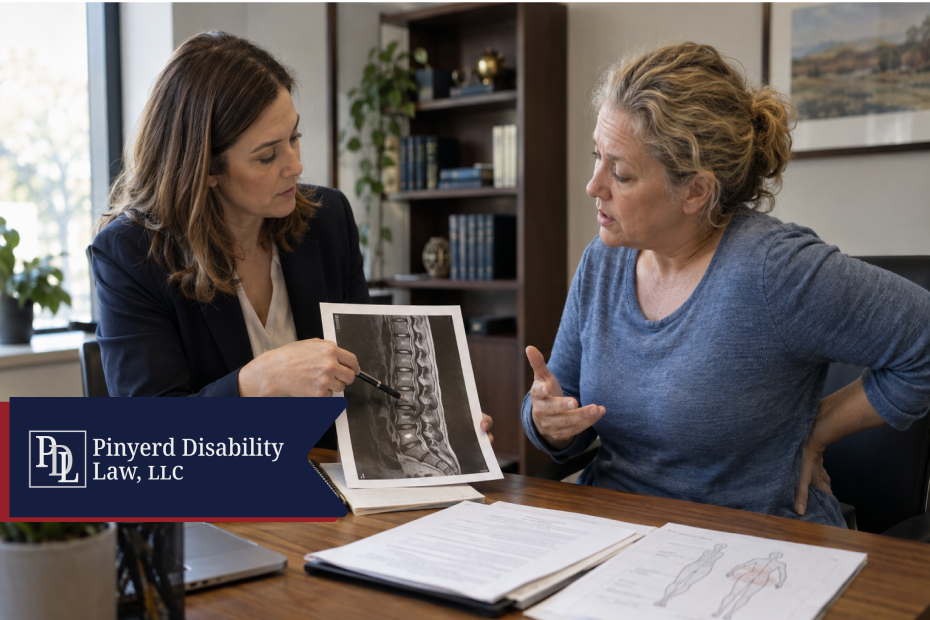
If you are researching SSDI for degenerative disc disease (DDD), you may be asking whether your diagnosis can support a claim. Degenerative disc disease appears on many imaging reports, but the report itself does not tell the whole story. What matters is how the condition affects your spine, nerves, movement, endurance, and ability to maintain a work schedule.
People with DDD may manage a medical appointment or lift something once, yet struggle through a workday that requires repeated movement. You may need to change positions or lie down as pain, numbness, weakness, and flare-ups build. After several hours, those symptoms can make a familiar job difficult to perform at a steady pace and schedule.
This guide explains how the Social Security Administration (SSA) evaluates DDD, which medical findings matter, and how to connect your symptoms to the actual demands of your work.
When Degenerative Disc Disease Affects Your Ability to Work
Degenerative disc disease describes changes in the discs between the vertebrae. Those changes can contribute to localized back or neck pain, stiffness, reduced range of motion, or pressure on nearby nerves. The effects depend on where the degeneration occurs and how it affects your body.
Lumbar DDD can make it difficult to stand, walk, bend, lift, or remain in one position. Cervical DDD can cause neck pain, headaches, numbness, or weakness that affects your arms and hands. When a disc problem irritates or compresses a nerve, pain or altered sensation may travel into a leg or arm, changing the way you move and use your strength.
For SSDI purposes, the important issue is the connection between those symptoms and your ability to work. Someone who loads materials, drives for hours, or works on their feet faces different challenges from someone who works at a desk. Your claim should show what happens when your condition meets the specific demands of your job.
Can SSDI for Degenerative Disc Disease Be Approved?
Yes, DDD can support an SSDI claim when the medical and vocational evidence shows that it prevents you from performing substantial work. Approval depends on the full record, including your diagnosis, examination findings, treatment history, symptoms, work background, and expected duration of the impairment.
You generally must show that your condition has lasted, or is expected to last, for at least 12 continuous months. You also need enough work credits and disability-insured status for SSDI. Medical eligibility and work-history eligibility are separate parts of the application, so both need attention before you file.
The SSA evaluates disability through a sequence of questions. It considers whether you are working at a substantial level, whether your impairment is severe, whether it meets or equals a listing, and whether you can still perform past relevant work. If you cannot return to that work, SSA considers whether you can adjust to another job.
If you are researching Social Security Disability Insurance benefits, the central point is simple: your DDD diagnosis starts the inquiry. The evidence must show what the condition keeps you from doing on a regular and continuing basis.

The SSA Rules That Apply to DDD
SSA’s Listing of Impairments, often called the Blue Book, sets out medical criteria for severe conditions. For DDD, the most relevant entries address nerve-root compromise and lumbar spinal stenosis. The listing analysis is one stage of the process; claims that do not satisfy a listing may still proceed to an RFC review focused on work capacity.
Listing 1.15 and nerve-root compromise
Some serious DDD cases fit the criteria for Listing 1.15, which addresses disorders of the skeletal spine resulting in compromise of one or more nerve roots. The listing looks for a consistent pattern involving radicular symptoms, neurological signs, imaging, and the required functional limitations.
Your records may describe pain or altered sensation that follows the path of an affected nerve. The examination may document weakness, sensory changes, reduced reflexes, or other neurological findings. Imaging then needs to support the clinical picture by showing a spinal problem consistent with nerve-root compromise.
This is why the phrase “disc degeneration” alone tells SSA very little about severity. The useful record connects the image to the symptoms you report and the findings your doctors observe.
Listing 1.16 and lumbar spinal stenosis
Listing 1.16 addresses lumbar spinal stenosis resulting in compromise of the cauda equina, a bundle of nerve roots at the lower end of the spinal cord. This type of stenosis can affect sensation, muscle strength, standing, and walking. The listing has its own requirements for neurological symptoms, imaging or operative findings, function, and duration.
You do not need to meet Listing 1.15 or 1.16 for your claim to succeed. SSA can continue to the residual functional capacity (RFC) analysis when a condition falls short of a listing. Medical equivalence may also apply when the combined evidence is at least equal in severity and duration to a listed impairment.
The listing analysis is one part of the process. Your complete claim should show how DDD affects you over time and how those effects fit with the work you have performed.
How DDD Can Affect Different Types of Work
For anyone considering SSDI for degenerative disc disease, the work-related impact gives the medical evidence practical meaning.
Consider someone who worked in a warehouse and developed lumbar DDD with radiating leg pain. The job may require frequent lifting, repeated bending, climbing, and walking across a concrete floor. Even when that person can manage a short errand, the same movements may become impossible after several hours of work.
Driving jobs create a different problem. Sitting for long stretches can increase pain and stiffness, while getting in and out of a vehicle adds repeated bending and twisting. Turning the head may also be difficult for someone with cervical DDD. Delivery work combines those postural demands with lifting and carrying, which can make the workday especially difficult to sustain.
Desk work has its own challenges. Sitting through a meeting does not necessarily show that you can remain seated for a full workday. You may need to stand, walk, recline, or change position more often than an employer will permit. Plus, medication side effects, pain flares, or numbness in the hands may also affect concentration, pace, attendance, or the ability to use a keyboard.
The RFC analysis asks what you can do reliably in a work setting. It considers strength, posture, movement, endurance, and other restrictions together with your age, education, and work history.

Medical Evidence That Strengthens a DDD Claim
In an SSDI for degenerative disc disease claim, medical evidence should tell a connected story. An MRI can show disc-space narrowing, herniation, stenosis, or other changes, while an examination explains how those findings affect your strength, sensation, reflexes, gait, or range of motion. Treatment records then show whether the problems continued, improved, or became more severe.
Your records may include imaging from a hospital or specialist, physical examinations, medication changes, physical therapy, surgical consultations, and reports about assistive devices. Each item adds context. A later note describing persistent weakness after months of treatment can carry a different meaning from an isolated scan taken before symptoms developed.
Your doctors’ records should also describe function in concrete terms. Can you sit for 30 minutes, two hours, or longer? How far can you walk before you must stop? What happens when you lift, bend, reach, or turn your neck repeatedly? Do you need to lie down during the day, miss appointments because of a flare-up, or spend the following day recovering from an ordinary activity?
Pain deserves careful documentation, too. SSA considers your statements about pain and other symptoms, along with medical findings and information from other sources. Your description becomes more useful when it explains frequency, triggers, intensity, duration, and the effect on daily activities and work tasks.
Keep the timeline clear. Explain when the condition began affecting your work, when symptoms worsened, which treatments you tried, and why you could no longer maintain the same pace or schedule. A consistent history helps the decision-maker understand the difference between a diagnosis on paper and a condition that has changed your working life.
Age and Past Work Can Change the Analysis
Age becomes especially important when SSA reaches the vocational part of the evaluation. Your past work, education, transferable skills, and ability to adjust to another occupation all matter at that stage. Someone who spent decades in heavy labor may face a difficult transition when DDD limits lifting, bending, standing, and walking.
The analysis also looks at the work you performed during the relevant period and the way that work was actually done. Describe the physical demands honestly. A job title rarely explains how often you lifted, how long you stood, whether you worked on ladders, or how much bending the position required.
If you are approaching or over age 60, review how the Social Security disability rules after age 60 may affect the vocational analysis.
Self-Employment and Ongoing Work
Self-employment creates a fact-specific work question. SSA may examine your earnings, hours, duties, accommodations, and the value of help from other people. A business owner might remain involved in limited tasks while another person handles lifting, scheduling, field work, or customer demands. Those details can change how SSA understands the work activity.
You should also report limited work accurately. Occasional work, a short trial, or duties performed with unusual assistance may tell a different story from regular work performed at a competitive level. Keep records showing what you did, how often you did it, and what your condition required you to leave for someone else.
Learn more about disability issues for self-employed workers if your work history includes a business, independent contracting, or family employment.
Working While You Apply for SSDI
Working during an application does not answer the entire disability question by itself. SSA considers whether your earnings and work activity rise to the level of substantial gainful activity, along with the medical and vocational evidence in your file.
For 2026, SSA lists the monthly SGA amount for non-blind individuals as $1,690. The figure changes over time, and special rules can apply to work attempts, subsidies, impairment-related expenses, and self-employment. Check the current SSDI earning limits before relying on a number in your planning.

DDD and Veterans Disability Benefits
Some veterans develop DDD during or after service, or experience a spinal condition alongside another service-connected impairment. VA disability compensation and SSDI use different eligibility standards, so a decision by one program does not automatically decide the other.
Your records may still need to tell the same medical story across both claims. Treatment notes, imaging, functional restrictions, and the history of your symptoms can help explain how your condition affects daily life and employment. If you are pursuing more than one benefit program, learn how veterans disability benefits fit into the broader picture.
A Practical DDD SSDI Evidence Checklist
Before filing, gather the records that show both the condition and its effect on your life:
- Imaging reports and the doctor’s explanation of what they show.
- Physical and neurological examination findings.
- Treatment records covering medications, therapy, injections, and specialist care.
- Notes about weakness, numbness, radiating pain, gait changes, or limited range of motion.
- A clear description of how long you can sit, stand, walk, lift, bend, and use your hands.
- Information about flare-ups, recovery time, missed work, and the need to change position.
- A work history that explains the physical demands of your past jobs.
- Evidence of other conditions that combine with DDD to limit your ability to work.
A symptom journal can help you remember patterns when you speak with your doctors or complete disability forms. It supports the medical record by showing how often problems occur and what they prevent you from doing.
If DDD Keeps You From Working, Pinyerd Disability Law Can Help
Living with DDD can make every part of the disability process feel heavier. You may wonder whether your records are strong enough, whether an MRI that says “mild” will hurt your claim, or how to explain the difference between completing an occasional task and sustaining a full work schedule. Those questions deserve a careful answer.
Pinyerd Disability Law, LLC helps people understand how their medical evidence, symptoms, and work history fit together. Our attorneys review the details of your situation, identify the issues that need attention, and guide you through the application or appeal process. You work with a legal team that understands how SSA evaluates disability claims and what decision-makers need to see.
If DDD has changed your ability to work, contact Pinyerd Disability Law, LLC to discuss your situation and the next step that makes sense for you.

FAQs: SSDI for Degenerative Disc Disease
1. Can I get SSDI for degenerative disc disease if my MRI says “mild”?
The wording on an imaging report does not decide the claim by itself. SSA considers the report alongside your symptoms, examination findings, treatment history, and ability to work. If “mild” degeneration still causes documented nerve symptoms, weakness, severe pain, or significant work restrictions, the complete record deserves careful review.
2. Do I have to meet a Blue Book listing to qualify for SSDI with DDD?
No. Meeting a listing is one route to approval. When your condition does not satisfy every listing requirement, SSA can assess your residual functional capacity and determine whether you can perform past relevant work or adjust to another job. Your age, education, work history, and specific restrictions matter during that analysis.
3. Can back pain alone support an SSDI claim?
Pain is an important part of many DDD claims, but SSA evaluates it alongside objective medical evidence and the rest of the record. Explain how often the pain occurs, what triggers it, how long it lasts, and how it affects sitting, standing, walking, concentration, attendance, and recovery after ordinary activities.
4. What medical records are most important for a DDD claim?
Start with complete records from the doctors who evaluated or treated you, including imaging, physical examinations, treatment history, and documented functional restrictions. Notes describing weakness, sensory changes, gait problems, limited movement, medication effects, and your response to treatment help show how DDD affects your ability to work over time.
5. Can I work part-time and still qualify for SSDI?
Possibly. SSA reviews your earnings and the nature of your work activity, along with your medical limitations. Part-time work performed with unusual assistance, frequent breaks, reduced duties, or repeated unsuccessful attempts may provide important context. Report the work accurately and preserve records showing what you could do and what others had to take over.